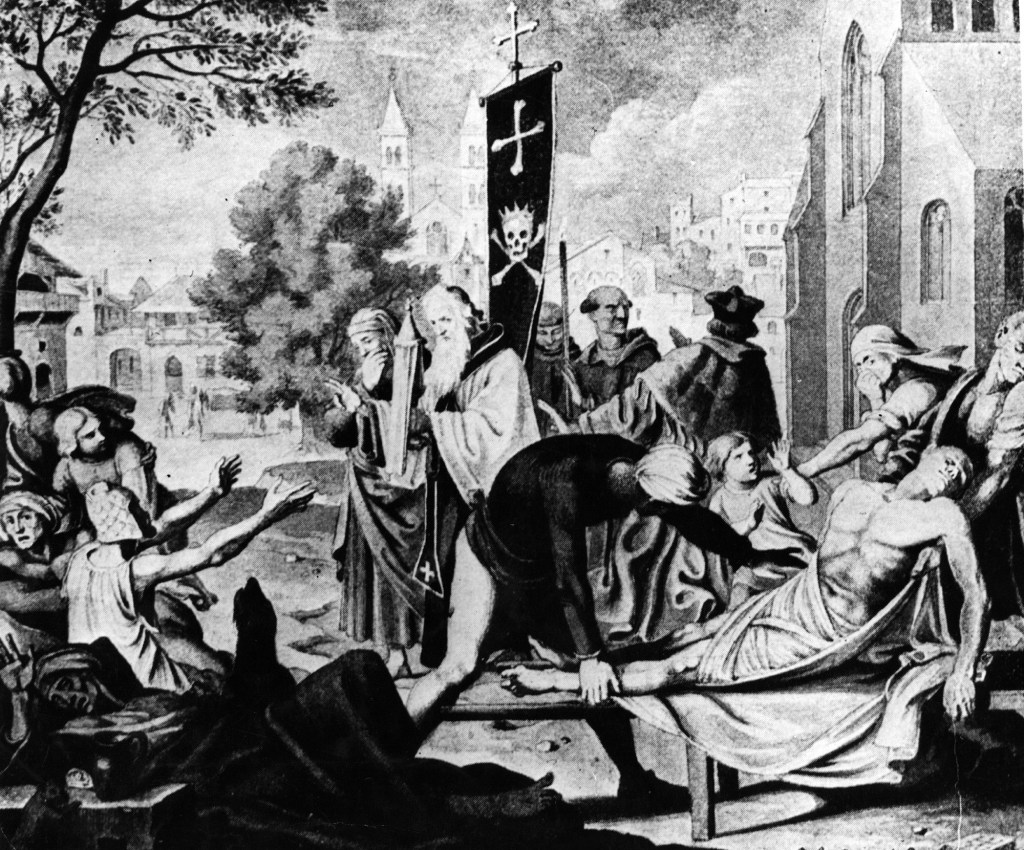
It’s important to look back and learn from those who surmounted similar challenges 700 years ago. Doing so may give us something we’re short on: hope.
First a technological innovation undermines the authority of governments, breaks down social structures and gives every person a power never before imaginable. Next, a pandemic claims millions of lives and devastates entire economies. Unrest rocks major cities — many flee to the countryside — and the darkest hatreds are released. People fear that the world will never be the same again, that uncertainty and danger will continue to afflict their lives. And yet, with upheaval comes change — social, economic and political — that’s potentially positive.
This is the way the world looks to many of us in the 21st century, but our sense of despair would surely feel familiar to 14th century Europeans. In a short period of time, from 1330 to 1380, they experienced not one but two seismic shocks that profoundly altered their reality. These transformations proved to be permanent, laying the foundations for the modern age. The result was rebellions, depressions, the collapse of power structures and war, but also scholarship, greater equality, prosperity and art.
As we wrestle with our contemporary challenges, it’s important that we look back and learn from those who survived and ultimately surmounted similar ones 700 years ago. Doing so may give us something we’re short on: hope.
The revolutions that would rock the 14th century began innocuously enough, with a simple iron tube. But once soldered at one end and punctured through the top, filled with black powder and loaded with a metal ball, the tube became known in Middle English as a “handgonne.” Invented in China and imported via the Silk Road, the earliest firearms purportedly reached Europe in 1326 and appeared on battlefields five years later.
Before then, medieval European society revolved around the invincibility of an armored knight fighting on horseback and ruling from his castle. Attaining these advantages required an immense amount of time for training and money, neither of which was available to the hardworking peasants. Knights and castles preserved a feudal system of enslaved serfs and all-powerful lords that lasted for some 600 years.
But then came the gun that shot feudalism down. Armed with this weapon, which was relatively inexpensive and easy to operate, the simplest farmer could defeat the best-mounted, thickest-coated knight. Many did in the peasant revolts that subsequently erupted. Naturally, the knights retreated to their castles, only to find that they were no longer impregnable, as well. These could now be destroyed by a larger version of the handgonne, also known as a cannon. Read More
 HEALTH STATUS